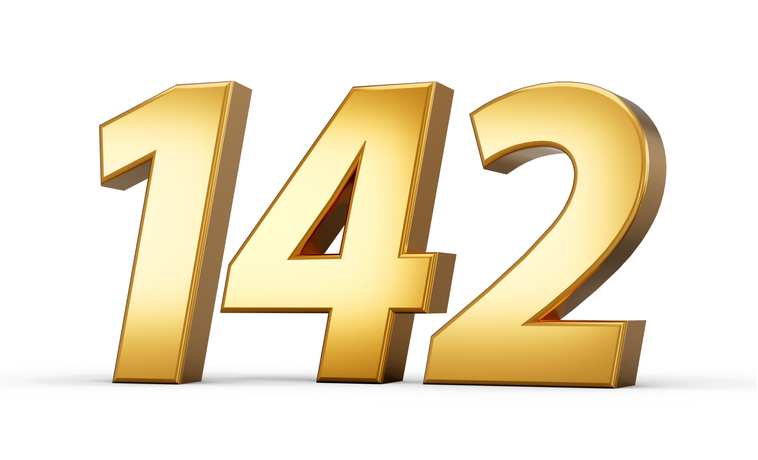
Numbers often carry meanings that stretch far beyond their simple mathematical identities. The number 142 is no exception. It sits quietly within the vast landscape of integers, yet holds historical, scientific, and cultural significance that stands out in subtle and fascinating ways.
Mathematically, the number 142 is known as a “sphenic” number, which means it is the product of three distinct prime numbers. The primes for 142 are 2, 71, and 1. Numbers with this unique structure often become objects of deeper study for mathematicians who seek to understand how prime combinations influence numerical patterns.
Science also offers an interesting connection to the number 142. Within the periodic table of elements, the isotope xenon 142 has been examined in research involving nuclear processes and atomic behavior. Though not the most common isotope, it contributes to the broader understanding of stable atomic structures and the ways isotopes behave during physical reactions. This is one more example of how the number 142 appears quietly but meaningfully across our world.
The number 142 can also be found in cultural references with varied significance. In some societies, it has been considered a lucky number and an auspicious sign of good fortune. In the Bible, the Book of Matthew Verse 1:42 references the birth of Christ as a fulfillment of Prophecy.
There is also something appealing about the structure of the number 142. It has a balanced rhythm when spoken aloud and its digits create a natural progression that makes it enjoyable to say and easy to remember.
Numbers serve symbolic functions, and while 142 may not be widely recognized as a cultural icon, its subtle references help maintain a quiet presence for the number across creative and historical worlds. All of these elements can lead to a conclusion that 142 is more than just another number, and that its importance goes beyond mathematics, science, and culture. It also has specific meaning for me personally. Our current literary and publishing industries present countless hurdles for promising poets and their work. For starters, fewer people today read original poetry than ever before, and even fewer purchase recently published books from new authors.
Because I am constantly researching and second-guessing my series of decisions made during the writing, editing, and publishing of my first book, I recently came across an industry report that concludes the average total book sales for a new American poets’ first published collection of poetry is 142. This includes the copies purchased by the author, as well as the author’s friends and family. I’m sure there are industry pundits and experts who disagree with this statistic. I’m equally sure there are many exceptions to it. Nevertheless, I also know numerous colleagues who say they would have been thrilled with selling 142 copies of their first self-published book. Personally, I am pleased and excited to learn that sales for my inaugural self-published book of poetry, From the Shallow End to the Deep End, has far exceeded the industry average with sales continuing to rise and stellar reviews continuing to pour in. Don’t get me wrong; I do not anticipate seeing the book on a best-seller list any time soon. That was never the goal. We are, however, seeing the book find its way to junior high, high school, and college classrooms for study and analysis of how newly written sonnets can adhere to Shakespear’s strict formal structure developed 450 years ago, but remain relevant today by addressing contemporary raw themes through the use of conventional language. This was very much the goal. I could not be more pleased with the progress of this debut book, and I promise we are just getting started!
Mathematically, the number 142 is known as a “sphenic” number, which means it is the product of three distinct prime numbers. The primes for 142 are 2, 71, and 1. Numbers with this unique structure often become objects of deeper study for mathematicians who seek to understand how prime combinations influence numerical patterns.
Science also offers an interesting connection to the number 142. Within the periodic table of elements, the isotope xenon 142 has been examined in research involving nuclear processes and atomic behavior. Though not the most common isotope, it contributes to the broader understanding of stable atomic structures and the ways isotopes behave during physical reactions. This is one more example of how the number 142 appears quietly but meaningfully across our world.
The number 142 can also be found in cultural references with varied significance. In some societies, it has been considered a lucky number and an auspicious sign of good fortune. In the Bible, the Book of Matthew Verse 1:42 references the birth of Christ as a fulfillment of Prophecy.
There is also something appealing about the structure of the number 142. It has a balanced rhythm when spoken aloud and its digits create a natural progression that makes it enjoyable to say and easy to remember.
Numbers serve symbolic functions, and while 142 may not be widely recognized as a cultural icon, its subtle references help maintain a quiet presence for the number across creative and historical worlds. All of these elements can lead to a conclusion that 142 is more than just another number, and that its importance goes beyond mathematics, science, and culture. It also has specific meaning for me personally. Our current literary and publishing industries present countless hurdles for promising poets and their work. For starters, fewer people today read original poetry than ever before, and even fewer purchase recently published books from new authors.
Because I am constantly researching and second-guessing my series of decisions made during the writing, editing, and publishing of my first book, I recently came across an industry report that concludes the average total book sales for a new American poets’ first published collection of poetry is 142. This includes the copies purchased by the author, as well as the author’s friends and family. I’m sure there are industry pundits and experts who disagree with this statistic. I’m equally sure there are many exceptions to it. Nevertheless, I also know numerous colleagues who say they would have been thrilled with selling 142 copies of their first self-published book. Personally, I am pleased and excited to learn that sales for my inaugural self-published book of poetry, From the Shallow End to the Deep End, has far exceeded the industry average with sales continuing to rise and stellar reviews continuing to pour in. Don’t get me wrong; I do not anticipate seeing the book on a best-seller list any time soon. That was never the goal. We are, however, seeing the book find its way to junior high, high school, and college classrooms for study and analysis of how newly written sonnets can adhere to Shakespear’s strict formal structure developed 450 years ago, but remain relevant today by addressing contemporary raw themes through the use of conventional language. This was very much the goal. I could not be more pleased with the progress of this debut book, and I promise we are just getting started!